

- Article
- Related
Although the geographical distance would have been a good enough reason to put the Creaform-Pinkbike venture to sleep, Roberts’s geek mind was already aroused. The project could thus go forth, for the sake of passionate bikers with a thirst for tech content and accurate data.
Below is Pinkbike’s metrology journey towards accurate measurements and reliable data for bike lovers.
Creaform was keen to support Dan Roberts in his efforts to make available rich and accurate suspension digits and data for avid readers looking for the real deal when it comes to biking. In the metrology industry, we offer particularly fast scanning instruments. Not only do our tools allow for a quick setup and a fast scan without surface preparation, the amount of time required to go from positioning targets to toying around with the 3D rendering is remarkably short.
And so, the team set out to find a Santa Cruz Megatower for the analysis. As luck would have it, the Mathieu Performance bike shop in Québec City (a few kilometres from Creaform’s head office) had a Megatower readily available for measurement in stock.
Now onto the actual mission: the Creaform team was tasked with going to said bike shop, measuring the pivot points, axles and tubes of the fork and seat post, and extracting their geometry. With that in mind, scanner portability was a staple feature, no excuses. Creaform was thus the most fit, convenient party to help in that matter.
Using 3D scanning technologies for this project also meant chasing for volumetric positioning accuracy, and the solution has delivered results in that matter, with an accuracy of 0.1 mm for distances ranging from one end of the bike to the other. Little did they know, this proved more than enough for the analysis and a tad finer compared to the manufacturing tolerances achievable in the bike industry.
1- Setting Up Quickly and Creating a Reference Frame

In order to generate a mesh, the scanner should have at least three targets at all times in its field of view, but since the geometry and material volume of a bike are generally sparse, a cardboard box was put behind the bike to affix more targets.
The HandySCAN 3D has a field of view of approximately 30 cm X 35 cm, so this means that targets should be positioned every 2-6 inches, in a random fashion. In the present case, they were positioned relatively close to one another, both on the carboard box and on the bike itself, since some components of the whole object being scanned displayed complex geometries, distinct features and various textures.
2- Redefining Accuracy in Scanning Mountain Bike Suspensions
3- Mesh: Calculating, Building, Processing
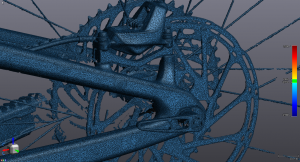
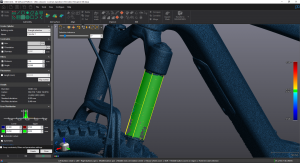
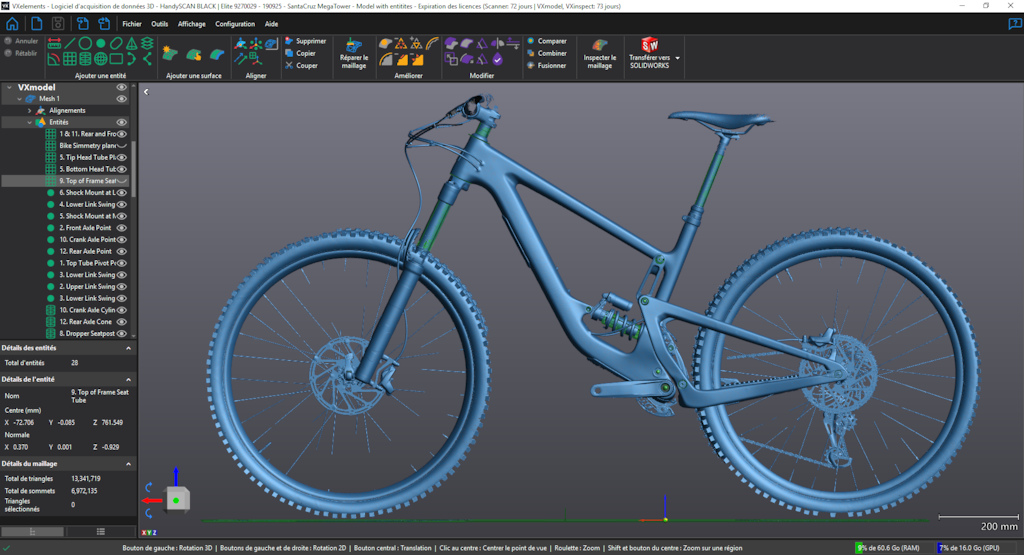
As one might expect, the scan can be fairly heavy, data-wise, and so a decimated version can be used to speed up the whole process. In the present case, the main elements that needed to be picked up were the pivot points, axles and tubes of the fork and seat post. Ultimately, the data captured from the extracted points would be used to display the geometry and kinematics of the bike.
It sounds like a lot of effort to get just a 2D sketch of the bike,
but it’s remarkably fast and the accuracy is so damn good
that we monitor the tolerances of individual parts of the bike.
– pinkbike.com
4- Output and Export to CAD Software
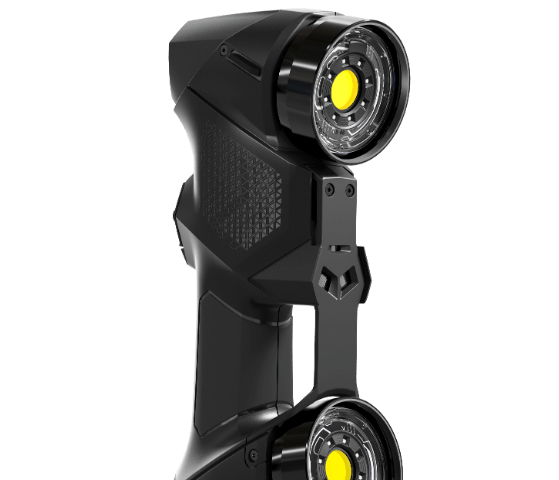
Features and Benefits: Accurate, Fast, Versatile, Portable, No Surface Preparation
The “Behind the Numbers” series wouldn’t be reliable if it weren’t for the accuracy of the actual numbers put forth. Creaform provided Dan Roberts with the means (overseas!) to accurately measure something the team was striving to depict, i.e., short-linked suspensions.
Now in full control of the digits, Dan Roberts proceeded to in-depth kinematic analyses of short-linked bikes to determine the actual numbers for the leverage ratio, anti-squat, anti-rise, axle path and so on.
The scan itself took a time of about 15 minutes
and the whole process went from set up to final 3D model in under an hour.
– pinkbike.com
With the benefit of hindsight, we can safely assume that the readers can put their entire trust in the “Behind the Numbers” series, for the content contributors took the ultimate step to ensure accuracy and confidence for the measurement of all bikes and layouts.
In the end, the joint venture unlocked the provision of accurate data for short-linked suspensions, potentially paving the way for more efficient methods of positioning pivot points, closer to what was intended at the design stage. But in reality, they barely scratched the surface of the host of possibilities 3D scanning has to offer in the mountain bike industry.
If they have not tried or implemented it already, manufacturers of all sectors could benefit from 3D scanning technologies to validate concepts, inspect and compare components, and create intelligent product designs.
Pinkbike and Creaform would like to extend their gratitude to Santa Cruz for being open for discussion and instrumental in the chase for accuracy and consistency. The same goes to the Mathieu Performance bike shop in Québec City who were kind enough to let us play around with their Santa Cruz Megatower for this project. And lastly, thanks to Dan Roberts, the instigator of the Behind the Numbers article that refers to Creaform’s 3D scanning technologies. Former Senior Bike Engineer at Scott Sports, Dan Roberts founded Garage Bike Project, an engineering consultancy oriented towards the bike industry based in Champéry, Switzerland.
Published 05/05/2020